
While most therapy for scoliosis is not effective, there are certain specific types of therapeutic exercise for scoliosis that does help. Whether or not physical therapy will be able to help you depends on if they are trained in scoliosis specific corrective exercises. The Schroth Method is an example of a three dimensional type of physical therapy exercise for scoliosis.

Understanding the three dimensional nature of scoliosis is critical to helping reduce curves. Unfortunately, most therapists only consider the lateral bending of a scoliosis. This is because a x-ray is only 2-dimensional image they can only show a portion of the scoliosis, not the rotational component. While x-rays do a good job of showing the bend of the spine from side to side, as measured by the Cobb Angle. (see illustration)
Unfortunately the rotational element in the physical therapy for scoliosis curve remains unseen to the therapist and as a consequence remains untreated. When only part of the problem is treated, the benefits can be expected to be limited as well.
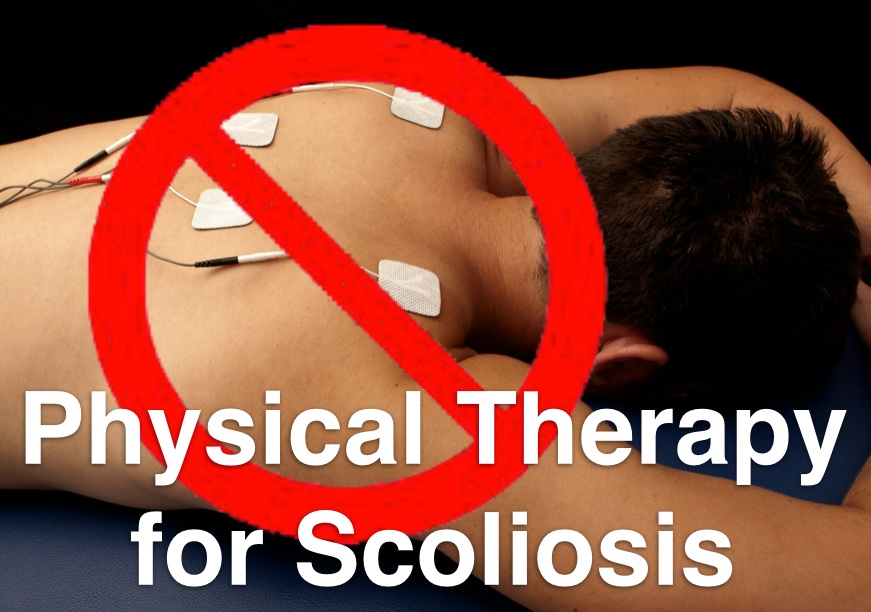
 Other types of physio-therapeutic modalities such as interferential current, electrical stimulation, diathermy, moist heat packs, ultrasound, etc. are often employed as a physical therapy for scoliosis. Although the application of these therapies may feel good and provide temporarily relief of pain when they are applied, they do nothing to correct the curves. None of these therapies have any documented therapeutic benefit for correcting scoliosis curvatures.
Because Physical therapy has been incomplete in treating scoliosis, many orthopedic surgeons believe that exercise therapy is ineffective. Yet, studies show that the right type scoliosis specific type of physical therapy is helpful.
What is the right type of physical therapy for scoliosis?
Physiotherapeutic Specific Scoliosis Exercises
Scoliosis exercises are specific to counteract the progression of specific scoliosis curvature and abnormal muscle patterns found in your scoliosis. Although movement IS an essential element in scoliosis treatment it is the specificity of the movement that really counts in reducing your curvatures.
While doing one exercise may reduce your scoliosis curvature, doing that same exercise in the opposite direction can actually worsen the scoliosis. To keep the curves from progressing or reducing the curves depends on doing the RIGHT KIND of movement exercises that also address the unseen element of scoliosis.
Rotation of Scoliosis
While most scoliosis curves when viewed on x-ray look like a side to side curve the reality is that there is far more to this lateral curve than meets the eye.
Because x-rays are a 2-dimensional representation of a 3-dimensional body, what looks like a flattened out “S” Curve on an x-ray is in reality more like helix of a spring in the body (see illustration).
This corkscrew shaped curve is caused by a unilateral rotation dysfunction of the deep postural muscle around the spine that is at the heart of scoliosis. To obtain any type of lasting correction or stabilization this muscular imbalance must be addressed. Unfortunately this 3-dimensional twist is far too often overlooked during physical therapy for scoliosis. There is a potential for dire consequences when the type of exercise for scoliosis is prescribed by therapists do not take this into consideration.
-
Avoid Physical Therapy for Scoliosis That Uses Bilateral Exercises
Bilateral Exercise for Scoliosis Can Actually Worsen your Scoliosis Curves!
It is a common practice in physical therapy for scoliosis to apply corrective exercises to both sides of the spine. For instance, exercises to help stretch the deep rotation muscles of the spine might be employed on both sides. The problem with that is that is contra-indicated for scoliosis. While rotation in opposite direction of the torque will serve to help correct unilateral rotation dysfunction, doing the exercises in the wrong direction will actually re-enforce the abnormal movement patterns thereby worsening the condition.
-
Lateral Scoliosis
Avoid Scoliosis Exercises That Only Deal With the Side to Side Element
Far too often physical therapy exercise for scoliosis takes a simplistic approach that focuses only on straightening the concave side of the curve. This is done in an attempt to reduce the Cobb Angle in the lateral dimension by looking to lengthen the shortened muscles on the concave side of the spine that have lead to decreased range of motion, joint fixation and lack of mobility of the spine on that side. They also work to strengthening the muscles on the convex curve that are over stretched and have resulted in joints that are hyper-mobile causing pain. The problem is that although they do address the lateral aspect of the curve this simplified approach totally fails to address the rotation component of the curve.
The rotation of the spine in scoliosis is one of the key elements of its formation. Most scoliosis curvatures are a severe manifestation of a rotational dysfunction of the spine and this element must be addressed if you are looking to succeed in halting the progression of the abnormal curves.
Here is an analogy to illustrate the inadequacy of this approach is to think of trying to straighten out a metal spring. Much like a spring, the spine in scoliosis is in a coil formation that not only curves side to side but also twists forward and back. If all you do is try and bend the spring from side to side you are never going to be able to effectively straighten it unless you also address the spiral bend in the coil.
Types of Physical Therapy for Scoliosis Exercise that DO Work
Scoliosis physical therapy for scoliosis exercise programs that are specifically designed to correct the unilateral rotation dysfunction in the spine are critical to the success of managing the abnormal curves. Those seeking therapy should search out a therapist who is specially trained in re-establishing proper movement patterns that are a significant problem in scoliosis is the one you want to seek out.
These properly trained therapists can help affect a positive change in the curvature through postural reeducation, muscle memory and activation of reflex systems through correctly applied scoliosis exercise programs. Exercise for scoliosis that specifically target the unilateral rotation dysfunction are most effective. Such programs as the Schroth Method do address this critical component and should be a part of any scoliosis exercise rehabilitative program.
In addition, depending on the severity of the curves, a flexible dynamic brace like the SpineCor Brace is often used in conjunction with these exercises to provide a constant, gentle reinforcement of the corrective motor patterns needed to de-rotate the spine keep the curve from progressively falling into the abnormal patterns that worsen the curvatures.
There are better alternatives to the standard physical therapy for scoliosis that are also available (ie: chiropractic, yoga, etc.) that have not been discussed here. Some forms of therapy are more effective than others.
In my personal case, when I started developing Scoliosis, my body adjusted in a way that it did not look my body as irregular except for the shape of my spine, however my shoulders and hips were symmetric, until I went through a bad surgery to correct the 60 degrees of my scoliosis and then things got worse. If exercises work, I recommend to follow a long physical therapy to undergo for surgical correction.
I would recommend that you consider a consult for the Schroth Method exercises for your back, even after surgery, as they may help improve some of your pain and spinal dysfunction.
hi! do you have any trained personnel who can do all this in Nigeria? thanks.
Ever since i was little i had one foot longer than the other so i was supposed to wear this heel thing inside my shoe, when i turned 12 nd hit puberty my scoliosis progresses and it got really bad within a year. i now have 37 degrees on my spine and i saw a video on youtube that told me about scoliosis systems and the spine cor brace and the excersise part really interested me but my question is, am i still able to do it with almost 40 degrees in my spine because i know that braces are for degrees in the 20s or so, so this is my question. =
Cinthya,
Thank you for your question. The answer is most likely yes we can help you with a 40 degree curvature. Many of the patients we help have 40 degree curvatures or greater so chances are we can help you too. I would suggest that you give us a call at (800) 943-1254 for a Free Telephone Consultation with one of our doctors to discuss the particulars of your case so that we can determine if you might be a candidate for our type of scoliosis treatments.
Hello,
I am from Pakistan and my daughter who is 14 years old has also got osteogenesis imperfecta and has had 14 surgeries of both her femurs by the rodding procdure.She has been walking independently but since last year I noticed a curve in her spine which led her right side of the ribcage to protude ….The doctor says she has a 37 degree curve.She has started to walk a few steps after her surgery but feels pressure near her back and tires easily…I feel the scoliosis is hindering her walking…She did have a leg difference of a little more than an inch and for a few years and last year she was injected with pamidronate and it was only after this in fusion that I noticed the curve in her back.Please tell me if you can help my daughter? I can forward her x-rays and bone density tests if there is hope….My cousins live in America and if need be I can ask them to meet you to discuss my daughters case with you…..Looking forward to hear from you as I can only depend on you to help me as I do not want to opt for surgery come what may….Kindly let me know if you have any consulting clinics in New York……
Regards,
Ambareen Taher
Ambareen Taher,
Thank you for your interest and sorry for the delay in getting back to you about your daughter. Her case is quite interesting from a clinical perspective but we would need more information first to see if it may be worth your while to make the trip to see us from Pakistan. While we do have an office in New York, we are currently opening an office in Saudi Arabia, which is closer to you.
Before we consider scheduling a consultation, please give us a call at (800) 943-1254 for a Free Phone Consult to discuss your daughters case to see if she may be a candidate for our treatment programs.
Sincerely,
Dr. Brett Diaz, D.C.
Scoliosis Treatment Alternatives
Good Evening, I’m from the Philippines, I would like to ask if scoliosis can be cured without surgery if you already have 60 degrees curved. I am now 17 years old. Would there be any chances that my curve will decrease if i will do braces and physical therapy exercises only?! thanks.
Ira,
I wouldn’t say that your scoliosis could be “cured” but there is a chance that your scoliosis curves could be improved or at least stabilized so that you could avoid surgery with a combination therapy that included SpineCor bracing and the Schroth Method. I would recommend looking at our YouTube channel ( http://www.youtube.com/user/drbrettdiazdc1?feature=results_main ) where we have over 70 of our patients all different ages talking about their experience with our treatment programs. I would look at the ones around your age with advanced curves, like yours and see what they have to say. We would of course need to review your case in more detail to see if we could likely help you but if you can come to the US for treatment then we should have a conversation about your scoliosis. Feel free to call me at (800) 943-1254 and we can review your case to find out if our treatments are right for you.
Dr. Brett Diaz, D.C.
Scoliosis Treatment Alternatives.